
Working at height is one of the most hazardous activities across industries such as construction, maintenance, telecommunications, wind energy, oil and gas, and industrial inspection. Whether workers are performing rope access operations, tower maintenance, façade cleaning, or rescue activities, selecting the correct rope is essential for safety and efficiency.
Ropes are often referred to as the lifeline of work-at-height operations because they support workers, prevent falls, and assist in rescue situations. However, not all ropes are designed for the same purpose. Understanding the types of rope used for working at height helps employers and workers choose the right equipment while improving workplace safety.
In this guide, we explain the most commonly used ropes in height safety applications and their specific uses.
Why Rope Selection Matters in Work at Height
The rope is one of the most critical components of any fall protection or rope access system.
Choosing the wrong rope can lead to:
- Reduced safety performance
- Increased wear and damage
- Difficult rope handling
- Higher accident risk
- Reduced operational efficiency
A properly selected rope provides reliable support, durability, and protection for workers operating in elevated environments.
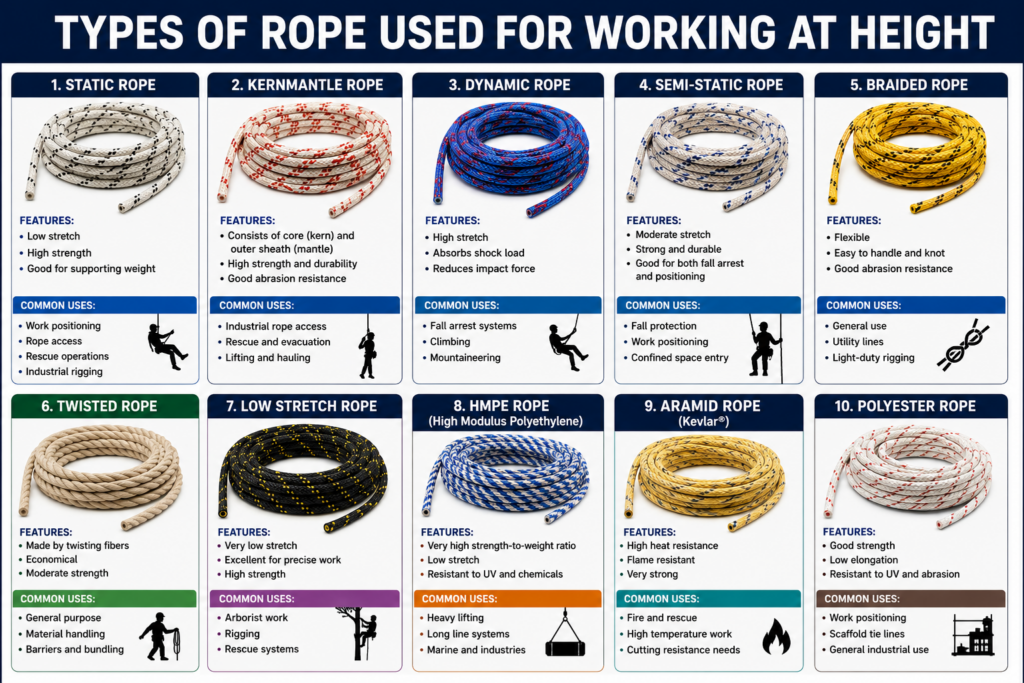
1. Static Rope
Static rope is one of the most widely used ropes in rope access and industrial climbing applications.
Unlike dynamic rope, static rope has very little stretch, making it ideal for situations where stability and controlled movement are required.
Common Uses of Static Rope
- Rope access work
- Building maintenance
- Industrial inspections
- Window cleaning
- Tower climbing
- Rescue operations
Advantages
- Minimal elongation
- Excellent load handling
- Better control during ascent and descent
- Suitable for long vertical work
Static ropes are often the preferred choice for professional rope access technicians.
2. Dynamic Rope
Dynamic rope is specifically designed to stretch under load.
This stretching capability helps absorb the energy generated during a fall, reducing the force transferred to the worker.
Common Uses of Dynamic Rope
- Climbing
- Fall arrest applications
- Mountaineering
- Adventure activities
- Rescue systems
Advantages
- Energy absorption
- Reduced impact force
- Enhanced fall protection
Dynamic ropes are not typically used as primary working ropes in industrial rope access systems but play an important role in fall protection scenarios.
3. Kernmantle Rope
Kernmantle rope is one of the most common rope constructions used in industrial safety applications.
The rope consists of:
- An inner core (kern) that provides strength
- An outer sheath (mantle) that protects against abrasion
Common Uses
- Rope access
- Fall protection
- Rescue operations
- Confined space entry
Benefits
- High strength
- Excellent durability
- Good abrasion resistance
- Long service life
Most professional work-at-height ropes are manufactured using kernmantle construction.
4. Low Stretch Rope
Low stretch ropes are specially designed for industrial rope access applications.
These ropes provide limited elongation while maintaining excellent strength and control.
Common Applications
- Rope access systems
- Rescue operations
- Industrial maintenance
- High-rise building work
Advantages
- Stable positioning
- Improved rope handling
- Better worker control
Low stretch ropes are commonly specified for professional work-at-height activities.
5. Rescue Rope
Rescue ropes are engineered for emergency situations where reliability and strength are critical.
These ropes are commonly used by:
- Emergency responders
- Fire rescue teams
- Industrial rescue personnel
- Confined space rescue teams
Features
- High tensile strength
- Enhanced durability
- Excellent performance under heavy loads
Rescue ropes are designed to perform under demanding conditions where lives may depend on the equipment.
6. Lifeline Rope
Lifeline ropes form part of personal fall protection systems.
They provide a secure connection between the worker and the anchorage point.
Common Uses
- Roof work
- Tower climbing
- Construction activities
- Maintenance operations
Benefits
- Continuous fall protection
- Enhanced worker safety
- Reliable anchorage support
Lifelines can be temporary or permanent depending on workplace requirements.
Materials Used in Working-at-Height Ropes
Nylon Rope
Nylon is known for its strength and elasticity.
Benefits include:
- High tensile strength
- Good shock absorption
- Excellent durability
Polyester Rope
Polyester ropes are widely used in industrial applications.
Advantages include:
- Low stretch
- UV resistance
- Chemical resistance
- Excellent durability
Polypropylene Rope
Polypropylene ropes are lightweight and water-resistant.
They are commonly used in non-critical applications where floating capability is required.
Key Factors to Consider When Choosing a Rope
Selecting the right rope requires evaluating several factors.
Load Capacity
Always ensure the rope is rated for the intended load and application.
Environmental Conditions
Consider exposure to:
- UV radiation
- Chemicals
- Moisture
- Extreme temperatures
Rope Diameter
Different applications require different rope diameters depending on equipment compatibility and load requirements.
Industry Standards
Choose ropes that comply with applicable safety standards and workplace regulations.
Intended Application
The rope should be selected specifically for:
- Rope access
- Rescue
- Fall protection
- Positioning
- Climbing
Rope Inspection and Maintenance
Even the highest-quality rope requires regular inspection.
Workers should check for:
- Cuts
- Abrasion
- Fraying
- Chemical damage
- Discoloration
- Excessive wear
Damaged ropes should be removed from service immediately.
Proper storage also helps extend rope lifespan.
Store ropes:
- Away from direct sunlight
- In dry environments
- Away from chemicals
- In dedicated rope bags or containers
Common Mistakes When Using Safety Ropes
Many rope-related incidents occur because of improper usage.
Common mistakes include:
- Using damaged ropes
- Incorrect rope selection
- Poor storage practices
- Lack of inspection
- Improper anchorage
- Inadequate worker training
Avoiding these mistakes significantly improves workplace safety.
Why Quality Rope Equipment Matters
Working at height involves serious risks, making equipment quality a critical factor.
SafeKraft India Pvt Ltd provides workplace safety solutions that support fall protection, rope access, rescue operations, and industrial safety requirements.
Using reliable, certified equipment helps organizations:
- Improve worker safety
- Reduce fall-related incidents
- Enhance compliance
- Increase operational efficiency
Conclusion
Understanding the types of rope used for working at height is essential for ensuring worker safety and successful operations. Static ropes, dynamic ropes, kernmantle ropes, rescue ropes, and lifeline ropes each serve specific purposes and should be selected based on workplace requirements.
Employers should combine proper rope selection with regular inspections, worker training, and effective fall protection systems to create a safer work environment. When working at height, the right rope can make the difference between a safe operation and a serious incident.
Frequently Asked Questions (FAQs)
1. What is the most commonly used rope for rope access work?
Static and low stretch kernmantle ropes are commonly used for professional rope access operations.
2. What is the difference between static and dynamic rope?
Static rope has minimal stretch and is used for positioning and access, while dynamic rope stretches to absorb fall forces.
3. What is a kernmantle rope?
A kernmantle rope consists of a strong internal core protected by an abrasion-resistant outer sheath.
4. Why is rope inspection important?
Regular inspection helps identify damage before it compromises worker safety.
5. How often should safety ropes be inspected?
Ropes should be inspected before each use and during scheduled safety inspections.
6. What rope material is commonly used in industrial applications?
Polyester and nylon are among the most commonly used materials for industrial safety ropes.
7. Can damaged ropes be repaired and reused?
No. Severely damaged ropes should be removed from service according to manufacturer guidelines.