
Safety shoes are one of the most important pieces of personal protective equipment (PPE) in industrial workplaces. Whether employees work in manufacturing plants, construction sites, warehouses, logistics facilities, or engineering units, the right safety footwear helps protect against slips, impacts, electrical hazards, chemicals, and extreme temperatures.
While many buyers focus on toe protection, the sole of a safety shoe plays an equally important role. Choosing the correct sole material improves safety, comfort, durability, and overall performance.
This guide explains the most common safety shoe sole types and helps you select the best option for your work environment.
Why the Sole Matters in Safety Shoes
The sole is the foundation of every safety shoe. It determines how well the footwear performs on different surfaces and under various workplace conditions.
A high-quality sole can provide:
- Slip resistance
- Shock absorption
- Chemical resistance
- Heat resistance
- Oil resistance
- Enhanced durability
- Improved worker comfort
Selecting the right sole reduces the risk of workplace injuries and increases productivity.
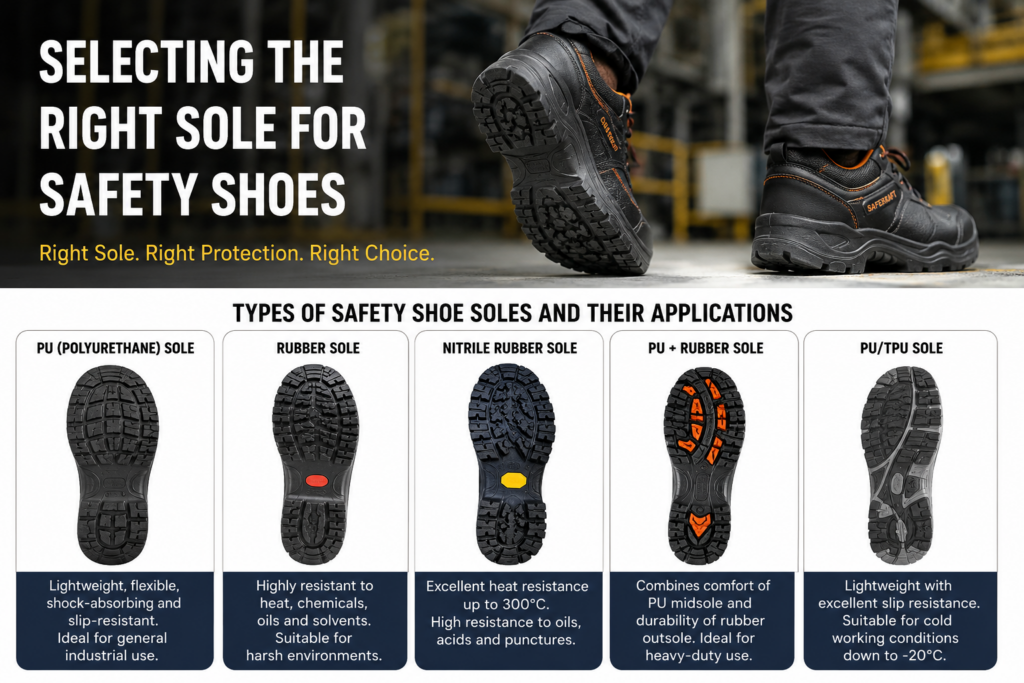
PU (Polyurethane) Sole Safety Shoes
Best For:
General manufacturing, warehouses, logistics, engineering workshops, and assembly units.
Advantages:
- Lightweight and flexible
- Excellent shock absorption
- Good slip resistance
- Resistant to oils and mild chemicals
- Low abrasion for longer service life
- Heat resistant up to approximately 120°C
Limitations:
- Moderate heat resistance
- Can degrade if stored unused for extended periods in humid conditions
PU sole safety shoes are among the most popular industrial safety shoes because they offer an excellent balance of comfort, durability, and affordability.
Rubber Sole Safety Shoes
Best For:
Chemical plants, refineries, oil & gas facilities, and heavy industrial environments.
Advantages:
- Outstanding resistance to chemicals and solvents
- Superior oil resistance
- Heat resistant up to approximately 300°C
- Excellent durability in harsh environments
Limitations:
- Heavier than PU soles
- Less flexible in very cold conditions
Rubber sole safety shoes are ideal when workers face chemical exposure and high-temperature risks.
Nitrile Rubber Sole Safety Shoes
Best For:
Foundries, steel plants, welding operations, and high-temperature workplaces.
Advantages:
- Excellent heat resistance up to 300°C
- Resistant to oils and industrial chemicals
- Better puncture resistance than standard rubber
- Long-lasting performance in demanding environments
Limitations:
- Higher cost compared to PU soles
- Slightly less flexible than TPU-based options
For workers exposed to hot surfaces and molten material, nitrile rubber soles provide reliable protection.
PU + Rubber Sole Safety Shoes
Best For:
Heavy-duty industrial applications requiring both comfort and durability.
Advantages:
- Lightweight PU midsole for comfort
- Strong rubber outsole for durability
- Excellent grip and slip resistance
- Better performance on rough surfaces
Limitations:
- Slightly more expensive than standard PU sole footwear
This combination offers the benefits of both materials and is a preferred choice for demanding industrial operations.
PU/TPU Sole Safety Shoes
Best For:
General industrial use, warehouses, cold-storage facilities, and outdoor work environments.
Advantages:
- Lightweight construction
- Excellent slip resistance
- Heat resistance up to approximately 130°C
- Cold resistance down to -20°C
- Enhanced durability and flexibility
Limitations:
- Higher cost than basic PU soles
- Moderate heat resistance compared to rubber options
PU/TPU safety shoes are an excellent choice for workers who need all-day comfort along with superior grip.
How to Choose the Best Safety Shoe Sole
Before purchasing safety footwear, evaluate:
- Workplace hazards
- Surface conditions
- Temperature exposure
- Chemical exposure
- Comfort requirements
- Duration of daily use
- Slip-resistance needs
The ideal safety shoe should provide the right balance of protection, comfort, stability, and durability for the specific working environment.
Choose SafeKraft Safety Shoes for Reliable Workplace Protection
At SafeKraft India Pvt. Ltd., we offer a wide range of certified safety shoes designed for diverse industrial applications. From lightweight PU sole safety shoes to heavy-duty rubber and dual-density sole footwear, our products are engineered to deliver superior safety, comfort, and long-lasting performance.
Explore our complete range of industrial safety shoes and select the right footwear solution for your workplace safety requirements.