
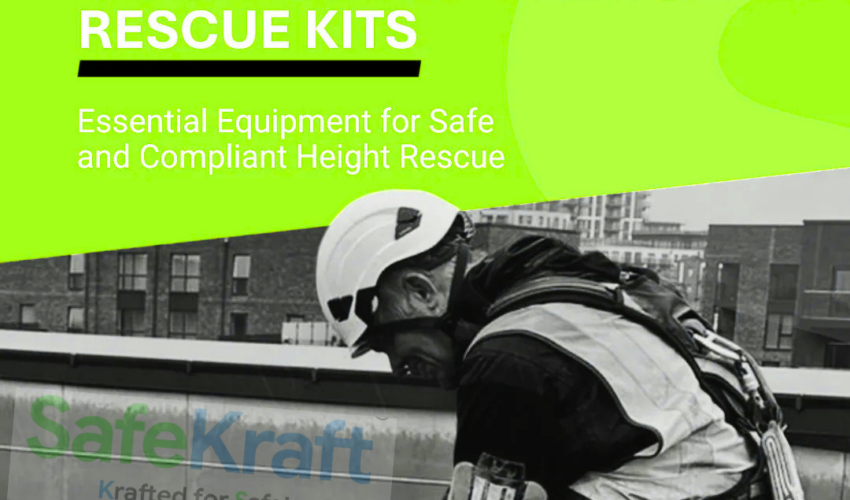
Working at height involves serious risks, particularly during maintenance, inspection, repair, and installation activities. When a worker is suspended after a fall, a quick and properly planned rescue response can be critical. Therefore, businesses working at height should consider not only fall protection equipment, but also suitable rescue equipment and procedures.
A maintenance and rescue kit brings together essential equipment that can support personnel working at height and help facilitate an organized rescue response when required.
SafeKraft’s SKWCK Maintenance & Rescue Kit is designed for personnel engaged in maintenance jobs at height. The kit combines several components intended to support work-at-height activities and emergency rescue requirements.
What Is a Maintenance & Rescue Kit?
A maintenance and rescue kit is a collection of work-at-height safety equipment assembled for personnel who perform maintenance tasks in elevated locations.
Working at height may involve:
- Building maintenance
- Industrial maintenance
- Construction work
- Structural inspection
- Installation work
- Equipment maintenance
- High-rise maintenance
- Industrial facility operations
In these environments, workers may need appropriate PPE for working at height, along with equipment that supports emergency rescue planning.
A suitable rescue kit can help organizations prepare for situations in which a worker becomes suspended after a fall or requires assistance while working at an elevated location.
SafeKraft SKWCK Maintenance & Rescue Kit
The SafeKraft SKWCK Maintenance & Rescue Kit is described as a kit intended to fulfill the requirements of personnel engaged in maintenance jobs at height.
According to the supplied SafeKraft catalogue information, the kit is designed to provide comfort and support to personnel working at height. It also includes specialized rescue equipment intended to enable immediate rescue of personnel when suspended at height after suffering a fall.
The kit shown in the catalogue includes several work-at-height safety components.
Components of the SKWCK Rescue Kit
The pictured kit includes:
- SKDSC-01
- SK-803
- SKRGFA
- SKFBH-56
- SKPR14-50
- SKKMR-50
- SK-100K
- SKKB
The exact configuration and intended use of each component should be confirmed from the manufacturer’s product documentation before use.
Why Is Rescue Planning Important for Work at Height?
Fall protection should not end with preventing a fall. Organizations should also consider what happens if an incident occurs.
A worker who falls and remains suspended in a harness may require prompt assistance. Consequently, employers should have an appropriate work-at-height rescue plan that considers the location, access, equipment, trained rescuers, communication, and emergency procedures.
A rescue plan should be developed before work begins rather than only after an incident occurs.
Fall Protection and Rescue Equipment
A comprehensive work-at-height safety approach can include several types of equipment.
Depending on the application, this may include:
- Full body harnesses
- Safety lanyards
- Rope systems
- Rope grabs
- Karabiners
- Rescue equipment
- Anchorage systems
- Lifelines
- Protective equipment
- Storage and carrying bags
The equipment selected should match the specific work environment and the manufacturer’s intended application.
Full Body Harness for Work at Height
A full body harness is commonly used as part of a personal fall-protection system.
The harness should be correctly fitted and connected to compatible equipment. Workers should also receive appropriate training before using fall-protection equipment.
The SafeKraft kit shown in the supplied catalogue includes the SKFBH-56 harness.
However, a harness alone does not provide a complete fall-protection or rescue system. The complete system must be designed around the workplace hazard and the equipment’s intended use.
Rope and Rescue Equipment
Rope-based equipment can play an important role in certain work-at-height and rescue applications.
The SKWCK kit shown in the catalogue includes SKPR14-50 and SKKMR-50 rope components.
Rope equipment must be selected according to the intended application, compatible components, applicable standards, and manufacturer’s instructions.
Rope Grab and Connectors
The catalogue image also shows the SKRGFA component and SK-100K connector.
Connectors and rope-grab devices should be used only according to their intended design. Compatibility between the harness, ropes, connectors, anchorage, and other components is essential.
Before use, workers should inspect equipment for visible damage, excessive wear, deformation, cuts, broken stitching, or other signs of deterioration.
Maintenance Safety at Height
Maintenance work can create additional challenges because workers may need to move between different positions while handling tools and equipment.
Therefore, a workplace safety plan should consider:
- The height of the work area.
- Access and egress routes.
- Anchorage availability.
- Fall hazards.
- Suitable PPE.
- Rescue access.
- Communication methods.
- Weather and environmental conditions.
- Worker training.
- Inspection of safety equipment.
A properly selected work-at-height safety kit can form one part of this overall safety strategy.
How to Choose a Work-at-Height Rescue Kit
Before purchasing a height safety rescue kit, businesses should evaluate their specific requirements.
1. Identify the Work Environment
Consider whether the work is being performed on:
- Buildings
- Industrial structures
- Towers
- Roofs
- Machinery
- Construction sites
- Elevated platforms
2. Identify Potential Rescue Scenarios
Consider how a worker could become stranded or suspended and how rescuers would safely reach the worker.
3. Check Equipment Compatibility
All components should be compatible and suitable for the intended rescue system.
4. Consider Training
Rescue equipment should not be used by untrained personnel. Workers and designated rescue teams should receive suitable instruction and practical training.
5. Inspect Equipment Regularly
Ropes, harnesses, connectors, lanyards, and other components should be inspected according to manufacturer recommendations and applicable safety requirements.
Storage and Maintenance of Rescue Equipment
Proper storage is important because rescue equipment can be affected by moisture, chemicals, sunlight, contamination, abrasion, and improper handling.
The SKWCK kit shown in the supplied catalogue includes SKKB, a SafeKraft carrying/storage bag.
Keeping equipment organized can also make it easier to locate the required components during an emergency.
However, storage does not replace regular inspection. Equipment should always be checked before use.
Importance of Worker Training
Even high-quality fall protection and rescue equipment cannot replace proper training.
Workers should understand:
- How to wear a harness correctly
- How to connect equipment
- How to inspect PPE
- What the equipment is designed for
- What limitations apply
- How to respond during an emergency
- Who is responsible for rescue
- How to communicate during an incident
Where specialized rescue equipment is used, designated personnel should be appropriately trained for the specific rescue procedure.
Workplace Safety Equipment for Complete Protection
Work-at-height equipment is only one part of a broader workplace safety program.
Businesses may also require:
- Head protection
- Eye protection
- Hand protection
- Foot protection
- High-visibility clothing
- Respiratory protection
- Hearing protection
- Fall protection
- Emergency equipment
SafeKraft provides a range of workplace safety equipment and protective gear for different industrial safety requirements.
Explore SafeKraft Workplace Safety Equipment
Workplace Safety Equipment & Protective Gear – SafeKraft
This is the most relevant internal link for this blog because it connects the work-at-height topic with SafeKraft’s broader workplace PPE and protective equipment range.
Frequently Asked Questions
What is a maintenance and rescue kit?
A maintenance and rescue kit is a collection of work-at-height equipment designed to support maintenance activities and emergency rescue requirements.
What is the SafeKraft SKWCK kit?
The SKWCK is a SafeKraft Maintenance & Rescue Kit shown in the supplied catalogue for personnel engaged in maintenance jobs at height.
What equipment is included in the SKWCK kit?
The supplied catalogue image shows SKDSC-01, SK-803, SKRGFA, SKFBH-56, SKPR14-50, SKKMR-50, SK-100K, and SKKB.
Why is rescue equipment important for working at height?
If a worker falls and becomes suspended, a planned rescue response may be necessary. Suitable rescue equipment can support an organization’s emergency response plan.
Is a safety harness enough for work at height?
No. A harness is only one component of a fall-protection system. The complete system may require suitable lanyards, connectors, anchorage, lifelines, rescue equipment, and other components depending on the application.
How often should rescue equipment be inspected?
Equipment should be inspected according to the manufacturer’s instructions, applicable requirements, and the conditions of use. It should also be checked before use for visible damage or deterioration.
Who should use a rescue kit?
Rescue equipment should be used by personnel who have been appropriately trained and understand the equipment, rescue procedure, limitations, and workplace hazards.
Conclusion
A well-planned maintenance and rescue kit can play an important role in workplace safety where employees perform maintenance activities at height. The SafeKraft SKWCK Maintenance & Rescue Kit combines several work-at-height and rescue-related components in one kit.
However, selecting equipment is only one part of effective height safety. Organizations should also develop appropriate rescue plans, provide worker training, inspect equipment regularly, and ensure that all components are compatible with the intended application.
For businesses looking for additional workplace safety equipment and protective gear, explore the SafeKraft range here: