
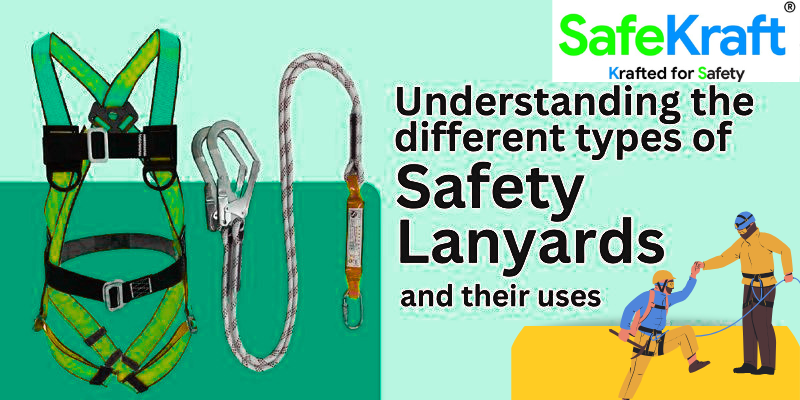
Working at height requires careful planning, suitable equipment, and proper training. A safety lanyard is an important component of many personal fall-protection systems. However, different lanyards are designed for different applications, so choosing the right type requires more than simply selecting a suitable length.
Rope construction, webbing material, connector compatibility, abrasion protection, inspection features, and the intended use should all be considered before selecting a lanyard.
In particular, work restraint lanyards are designed to restrict a worker’s movement so that the worker cannot reach an area where a fall could occur. This is different from a fall-arrest system, which is designed to stop a fall after it happens.
What Is a Safety Lanyard?
A safety lanyard is a connecting component used as part of a personal fall-protection or work-restraint system.
Depending on the system, a lanyard may connect a worker’s harness or other compatible body-support equipment to a suitable anchorage or another component of the protection system.
The complete system must be selected and used correctly. A lanyard should not be considered independently from the harness, connectors, anchorage, and the work environment.
For work-restraint applications, the system is arranged so that the worker can perform the required task while being prevented from reaching a fall hazard.
Why Is Choosing the Right Lanyard Important?
Not all workplaces have the same requirements.
A construction worker, maintenance technician, industrial worker, roofing professional, or utility worker may encounter different conditions. Therefore, the lanyard should be selected according to the specific application.
Important considerations include:
- Type of work
- Required working distance
- Anchorage arrangement
- Rope or webbing construction
- Lanyard length
- Connector type
- Abrasion exposure
- Environmental conditions
- Compatibility with other PPE
- Applicable standards
- Inspection and maintenance requirements
HSE guidance also emphasizes considering the length, type, and number of ropes and lanyards along with anchorage and other components when selecting a personal fall-protection system.
Types of Safety Lanyards
Several types of lanyards are used for workplace restraint and fall-protection applications.
1. Twisted Rope Lanyards
Twisted rope lanyards are commonly manufactured from high-strength rope materials.
The SafeKraft information provided for this range describes 14 mm polyamide twisted rope lanyards. The spliced ends are protected with a transparent protective sleeve, allowing the splice to remain visible for inspection.
The loops are also protected with an abrasion-resistant thimble. This helps reduce damage caused by contact between the rope loop and metallic connectors.
The stated available lengths are:
- 1.0 m
- 1.5 m
- 1.8 m
- 2.0 m
The supplied SafeKraft information states that these lanyards are individually certified according to EN 354:2010, with a minimum breaking strength of 22 kN.
2. Kernmantle Rope Lanyards
Kernmantle rope lanyards use a rope construction consisting of a core and protective outer covering.
The SafeKraft range shown in the supplied material uses 11 mm kernmantle rope.
These lanyards are cross-stitched and protected with a transparent covering sleeve. The sleeve also makes the stitching visible, which can assist with inspection before use.
The loops feature an abrasion-resistant thimble to help protect them from metallic connector contact.
Another feature described is a coloured tracer strand. According to the supplied material, the tracer loses its colour over time, indicating that the lanyard may no longer be suitable for further use.
3. Webbing Lanyards
Webbing lanyards provide another option for work-restraint applications.
The SafeKraft information describes 44 mm wide polyester webbing made from high-tenacity polyester yarn.
The loops are protected with an abrasion-resistant covering to help protect the webbing from damage caused by metallic connectors.
Webbing construction can provide useful flexibility for certain workplace applications, but the lanyard must still be selected according to the intended use and manufacturer’s instructions.
4. Polypropylene Twisted Rope Lanyards
Polypropylene twisted rope lanyards are another type of rope lanyard.
The supplied SafeKraft information describes these as 12 mm diameter polypropylene twisted rope lanyards.
Like the polyamide rope version, the spliced end is protected by a transparent protective sleeve. The loops are also protected with an abrasion-resistant thimble.
The listed lengths are:
- 1.0 m
- 1.5 m
- 1.8 m
- 2.0 m
The supplied material states certification according to EN 354:2010 and a minimum breaking strength of 22 kN.
Work Restraint vs Fall Arrest
One of the most important things to understand is the difference between work restraint and fall arrest.
Work Restraint
A work-restraint system is designed to prevent the worker from reaching a location where a fall could occur.
For example, a correctly configured system can allow a worker to move around a roof while restricting access to the unprotected edge.
HSE guidance recommends using work-restraint systems in preference to fall-arrest systems where practicable.
Fall Arrest
A fall-arrest system is different. It is designed to arrest a fall if one occurs.
Such systems require careful consideration of anchorage, clearance, equipment compatibility, and rescue arrangements. HSE guidance notes that fall-arrest systems should incorporate suitable energy absorption or energy-dissipating elements and that adequate clearance is required beneath the working area.
Therefore, a standard restraint lanyard should not automatically be treated as a fall-arrest lanyard. The equipment must be used only for its intended application and according to the manufacturer’s instructions.
How to Select the Correct Lanyard
Before purchasing a work restraint lanyard, consider the following points.
Identify the Work Application
First determine what the worker needs to do and where the work will take place.
Determine the Required Length
A lanyard should provide enough movement for the task while remaining appropriate for the intended restraint system.
Longer is not always better. In a restraint application, the objective is to prevent the worker from reaching the fall hazard.
Check the Rope or Webbing
Consider whether a rope or webbing lanyard is more appropriate for the work environment.
Check the Connectors
Connectors must be compatible with the harness, anchorage, and other system components.
Check for Abrasion Protection
Rope and webbing can be exposed to wear during use. Protective sleeves and thimbles can help protect vulnerable connection and loop areas.
Check Standards and Certification
Always review the applicable standard, product marking, certification information, and manufacturer’s documentation before using a lanyard.
Consider Inspection
Rope and webbing equipment should be inspected regularly. HSE guidance specifically highlights the need for care when inspecting equipment made from webbing or rope because these materials can deteriorate.
Inspect Safety Lanyards Before Use
A visual inspection should be part of normal PPE use.
Look for:
- Cuts
- Fraying
- Broken stitching
- Damaged rope
- Excessive abrasion
- Damaged protective sleeves
- Damaged thimbles
- Connector damage
- Unusual discoloration
- Signs of chemical or environmental damage
If equipment shows damage or there is doubt about its condition, it should be removed from service and assessed by a competent person according to the manufacturer’s procedures.
Why Connector Compatibility Matters
A lanyard does not work as an isolated product. It forms part of a complete protection system.
The harness, lanyard, connectors, anchorage and other components must be compatible.
HSE guidance similarly states that the components of a personal fall-protection system should be compatible with one another and that workers should receive appropriate training before using the equipment.
Choosing Quality Workplace Fall-Protection Equipment
Businesses purchasing fall protection equipment should look beyond price alone.
Quality, application, certification, material construction, inspection requirements, connector options, and manufacturer information should all be considered.
For businesses exploring broader PPE categories, SafeKraft provides a range of workplace safety equipment and protective gear, making it a useful related resource for organizations reviewing their overall workplace protection requirements.
Frequently Asked Questions
What is a work restraint lanyard?
A work restraint lanyard is used as part of a system designed to prevent a worker from reaching a location where a fall could occur.
What is the difference between restraint and fall arrest?
Restraint is designed to prevent the worker from reaching the fall hazard. Fall arrest is designed to stop a fall after it occurs.
What types of rope lanyards are available?
Common types include twisted rope and kernmantle rope lanyards. Different rope materials and constructions can be selected according to the application.
What is a webbing lanyard?
A webbing lanyard uses textile webbing rather than rope. The supplied SafeKraft information describes a 44 mm polyester webbing lanyard.
What lengths are available?
The SafeKraft information supplied for the lanyards lists lengths of 1.0 m, 1.5 m, 1.8 m and 2.0 m, depending on the lanyard type.
Why are lanyard loops protected with a thimble?
An abrasion-resistant thimble helps protect the rope loop from damage caused by contact with a metallic connector.
Should lanyards be inspected?
Yes. Rope and webbing equipment should be inspected regularly and before use according to the manufacturer’s instructions and applicable requirements.
Can any lanyard be used for fall arrest?
No. A lanyard should only be used for the application for which it is designed and approved. Work-restraint lanyards should not automatically be substituted for energy-absorbing fall-arrest equipment.
Conclusion
Selecting the right safety lanyard is an important part of a properly planned work-at-height safety system. Twisted rope, kernmantle rope, webbing, and polypropylene lanyards can serve different requirements, but the correct choice depends on the application, system configuration, length, connectors, materials, standards, and inspection requirements.
For work-restraint applications, the objective is to prevent workers from reaching a position where a fall can occur. Where fall arrest is required, a suitable fall-arrest system with appropriate energy absorption, anchorage, clearance, training, and rescue planning must be considered.
For more workplace PPE categories and protective equipment, visit: