
Working at height is a common requirement in construction, industrial maintenance, roofing, welding, painting, telecom, oil and gas, power, warehousing, and other industries. However, even a short fall can cause serious injury when the right safety measures are not in place.
A properly planned fall protection system helps prevent falls where possible and, when a fall cannot be prevented, helps arrest the fall and reduce the forces acting on the worker. Therefore, selecting suitable fall protection equipment and using it correctly should be an essential part of every work-at-height safety plan.
At SafeKraft, we provide a range of fall protection solutions designed for work-at-height applications, including full body harnesses, ropes, lanyards, rope grabs, fall arresters, lifelines, anchorage components, kits, and related safety equipment.
What Is Fall Protection?
Fall protection refers to the systems, equipment, procedures, and safety practices used to protect workers from falls while working at height.
A complete fall protection system can help:
- Prevent a worker from reaching a fall hazard
- Restrain a worker from falling
- Arrest a fall when it occurs
- Reduce the impact associated with a fall
- Provide suitable connection to an anchorage point
- Support safe rescue and recovery procedures
A fall protection system should not simply be viewed as a collection of PPE. Instead, it should be planned around the actual work environment, fall hazards, anchorage requirements, equipment compatibility, and worker training.
Why Is Fall Protection Important?
A fall can happen unexpectedly during routine work. For example, workers may face fall hazards while working on roofs, scaffolds, platforms, ladders, structures, elevated machinery, or construction sites.
Common activities where fall protection may be required include:
- Construction work
- Roof maintenance
- Painting
- Welding
- Repair and maintenance
- Loading and unloading
- Bricklaying
- Industrial installation
- Telecom work
- Oil and gas operations
- Power and energy work
- Warehouse and logistics activities
Even when the working height appears relatively low, the surrounding conditions can create additional risks. Therefore, employers and workers should identify hazards before starting the job and select appropriate controls.
Fall Prevention vs Fall Arrest
One of the most important concepts in work-at-height safety is understanding the difference between fall prevention and fall arrest.
Fall Prevention System
A fall prevention system is designed to prevent the worker from reaching or falling from a hazardous location.
Examples include:
- Guardrails
- Barriers
- Boundary cables
- Walls and fences
- Platforms
- Scaffolds
- Properly designed work platforms
- Aerial lifts and suitable access equipment
Whenever practical, preventing a fall is preferable to relying only on a system that catches a worker after a fall.
Fall Arrest System
A fall arrest system is designed to stop a worker after a fall has started.
A personal fall arrest system may include:
Anchorage + Full Body Harness + Connecting Element + Energy Absorbing/Fall Arrest Device
The equipment must be selected, connected, inspected, and used according to the manufacturer’s instructions and applicable safety requirements.
Active and Passive Fall Protection Systems
Fall protection methods can also be broadly understood as active and passive systems.
Active Fall Protection
Active systems require the worker to interact with or correctly use the equipment.
Examples include:
- Full body harnesses
- Lifelines
- Lanyards
- Energy absorbing lanyards
- Rope grabs
- Self-retracting lifelines
- Anchorage connectors
Because these systems depend on correct use, training, inspection, and proper connection are extremely important.
Passive Fall Protection
Passive systems generally remain installed without requiring continuous user interaction.
Examples include:
- Guardrails
- Safety nets
- Permanent barriers
- Protective structures
These systems can provide protection without requiring the worker to continuously connect and disconnect personal equipment.
ABCD of Fall Protection
A useful way to understand a personal fall arrest system is through the ABCD approach.
A – Anchorage
The anchorage is the secure point or structure to which a fall protection system is connected.
Depending on the application, anchorage solutions can include:
- Anchorage hooks
- Anchorage connectors
- Anchorage slings
- Lifeline systems
- Structural attachment points
The anchorage must be suitable for the intended application and installed according to applicable requirements.
B – Body Support
A full body harness provides the primary body support for a personal fall protection system.
A harness may include:
- Shoulder straps
- Thigh straps
- Waist belt
- Adjustment buckles
- Chest connection
- Dorsal D-ring
- Work-positioning attachment points, where applicable
The harness should fit correctly and be adjusted before use.
C – Connecting Elements
Connecting elements create the connection between the worker’s harness and the anchorage system.
Examples include:
- Single lanyards
- Twin lanyards
- Energy absorbing lanyards
- Rope lanyards
- Karabiners
- Snap hooks
- Rope grabs
- Lifeline connectors
The connecting equipment should be compatible with the harness and anchorage.
D – Deceleration / Fall Arrest Device
A deceleration or fall arrest device helps manage the forces generated during a fall.
Examples include:
- Energy absorbers
- Self-retracting lifelines
- Fall arresters
- Suitable rescue or descent devices
The correct device depends on the application, working environment, required movement, and system design.
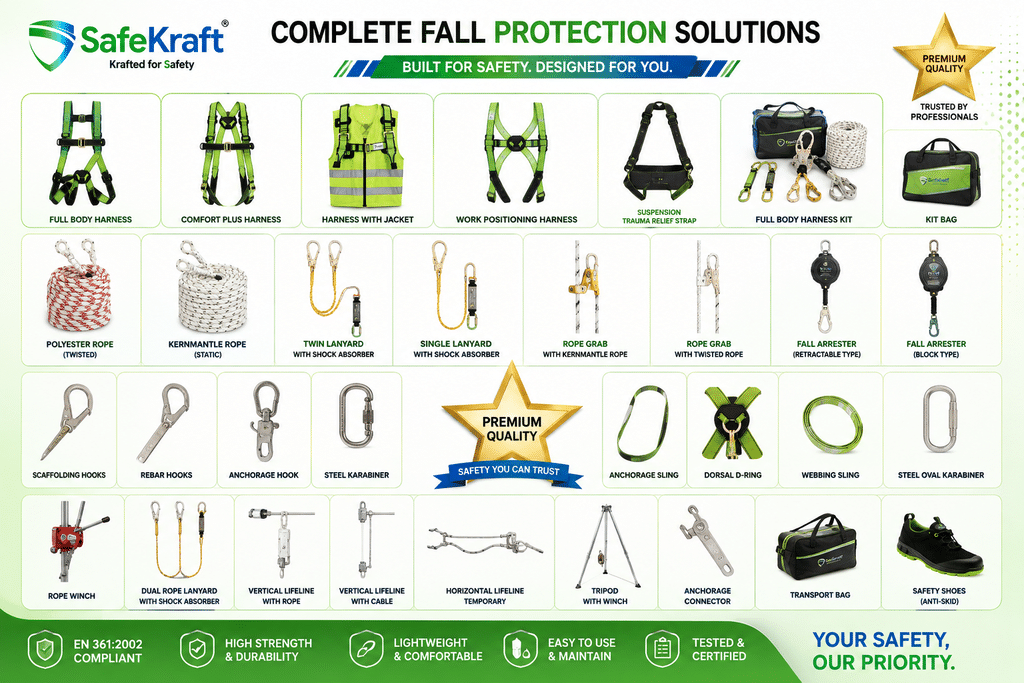
Complete Range of Fall Protection Equipment
SafeKraft’s fall protection range covers several important categories used in work-at-height applications.
1. Full Body Harness
A full body harness is an important component of a personal fall protection system.
It distributes forces through appropriate areas of the body and provides designated attachment points for compatible fall protection equipment.
SafeKraft offers different harness configurations, including:
- Full Body Harness
- Comfort Plus Harness
- Harness with Jacket
- Work Positioning Harness
The right harness should be selected according to the work activity and required attachment configuration.
2. Full Body Harness Kit
A full body harness kit combines essential fall protection components into a convenient set.
Depending on the configuration, a kit may include a harness, lanyard, connectors, rope or other compatible components.
A complete kit can make it easier for organizations to standardize equipment for specific work-at-height applications.
3. Harness with Jacket
A harness with a high-visibility jacket combines visibility with harness functionality.
It can be useful in applications where workers need to remain visible while working around construction areas, industrial sites, roads, warehouses, or other active work environments.
4. Work Positioning Harness
A work positioning harness is designed for applications where workers need support while performing tasks at height.
It can be used with compatible positioning equipment according to the application and manufacturer’s instructions.
5. Suspension Trauma Relief Strap
A suspension trauma relief strap can be used as part of a planned fall protection system to provide the worker with a means of changing leg position after suspension.
However, it should not replace proper rescue planning. A suitable rescue procedure should always be established for work-at-height activities.
6. Safety Ropes
Safety ropes are used with compatible fall protection systems and devices.
SafeKraft’s range includes different rope types, such as:
Polyester Rope
Polyester ropes can be used for suitable fall protection and access applications when matched with compatible equipment.
Kernmantle Rope
Kernmantle rope consists of a core and protective outer sheath. It is commonly used with compatible rope-based fall protection equipment.
Rope selection should consider diameter, construction, compatibility, intended application, and manufacturer’s instructions.
7. Safety Lanyards
Lanyards connect the worker’s harness to an appropriate anchorage or fall protection device.
Common options include:
Single Lanyard with Shock Absorber
An energy-absorbing lanyard is designed to help manage fall arrest forces when used as part of a compatible fall arrest system.
Twin Lanyard with Shock Absorber
A twin-leg lanyard can support applications where the worker needs to move between connection points while maintaining an appropriate connection.
Dual Rope Lanyard with Shock Absorber
Rope-based lanyards can be selected for specific work-at-height applications when compatible with the complete system.
8. Rope Grab
A rope grab is designed to travel along a compatible lifeline and provide fall protection when used according to its intended application.
SafeKraft offers rope grab options for compatible:
- Kernmantle rope
- Twisted rope
The rope grab and rope must be compatible. Using mismatched components can compromise the intended performance of the system.
9. Fall Arresters
Fall arresters are designed to form part of a personal fall arrest system.
SafeKraft’s range includes:
- Retractable fall arresters
- Block-type fall arresters
A retractable system can provide controlled movement while maintaining a connection to the worker. The correct model should be selected according to working height, required mobility, anchorage arrangement, and manufacturer’s specifications.
10. Scaffolding Hooks
Scaffolding hooks provide connection options for suitable work-at-height applications.
They can be used with compatible lanyards and harness systems where the hook and structure are suitable for the intended connection.
11. Rebar Hooks
Rebar hooks are designed for suitable connections around compatible structural or reinforcement elements.
Before use, workers should verify that the connection point and hook are appropriate for the specific application.
12. Anchorage Hooks and Connectors
Anchorage components provide a connection between the fall protection system and a suitable structural anchorage.
The range can include:
- Anchorage hooks
- Anchorage connectors
- Anchorage slings
- Webbing slings
- Steel karabiners
- Steel oval karabiners
The anchorage is one of the most important parts of the system, so it should always be selected and installed appropriately.
13. Dorsal D-Ring
The dorsal D-ring is commonly positioned at the back of a full body harness and can provide a fall arrest attachment point when designed for that purpose.
Workers should always check the harness marking and manufacturer’s instructions to understand the purpose of each attachment point.
14. Lifeline Systems
Lifelines provide continuous or controlled connection for suitable work-at-height applications.
SafeKraft’s fall protection range includes:
- Vertical lifeline with rope
- Vertical lifeline with cable
- Temporary horizontal lifeline
The correct lifeline depends on the structure, movement requirements, number of users, installation method, and system design.
15. Rope Winch
A rope winch can be used in suitable rope-based work-at-height or rescue applications.
Its application should be determined by the system design and manufacturer’s instructions rather than using it as a general-purpose lifting device.
16. Tripod with Winch
A tripod with winch can form part of a suitable access, retrieval, or rescue system.
Tripod systems are commonly considered for applications where controlled entry and retrieval are required. Proper system selection, setup, inspection, and worker training are essential.
17. Horizontal Lifeline
A temporary horizontal lifeline can allow suitable movement along a horizontal work area while maintaining connection to the fall protection system.
Before installation, the structure, span, number of users, clearance, and other system requirements should be assessed.
18. Vertical Lifeline
A vertical lifeline can provide fall protection for workers moving vertically along suitable structures.
SafeKraft offers rope and cable-based vertical lifeline solutions for appropriate applications.
19. Transport and Kit Bags
Fall protection equipment should be stored and transported carefully.
Suitable fall protection kit bags and transport bags help keep equipment organized and make it easier to carry harnesses, lanyards, ropes, and related components to the work area.
20. Safety Shoes for Work-at-Height Applications
Footwear is also an important part of workplace safety.
Safety shoes with suitable slip-resistant soles can provide grip and protection while workers move around industrial and construction environments.
However, safety footwear should complement—not replace—the required fall protection system.
Hierarchy of Fall Protection
Fall protection planning should follow a structured approach. A commonly used hierarchy starts with controlling the hazard before relying on personal protective equipment.
1. Elimination
Remove the need for workers to access the fall hazard whenever reasonably possible.
2. Fall Prevention
Use systems such as guardrails, barriers, or restraint systems to prevent the worker from reaching the fall hazard.
3. Fall Arrest
Where a fall cannot reasonably be prevented, use an appropriately designed fall arrest system to arrest the fall.
4. Administrative Controls
Use procedures such as:
- Warning signs
- Controlled access zones
- Work-at-height procedures
- Training
- Supervision
- Permit systems
5. Personal Protective Equipment
Fall protection PPE provides an important layer of protection for workers when properly selected and used.
A strong safety program can combine several of these controls rather than depending on a single measure.
How to Choose Fall Protection Equipment
Selecting fall protection equipment should begin with a proper hazard assessment.
Consider:
1. Work location
Is the work being performed on a roof, tower, scaffold, platform, structure, or another elevated location?
2. Type of movement
Does the worker need to climb, move horizontally, work in one position, or access multiple areas?
3. Fall hazard
Identify open edges, fragile surfaces, unprotected platforms, ladders, openings, and other potential hazards.
4. Anchorage
Determine where a suitable anchorage can be established.
5. Clearance
Consider the available fall clearance and the potential movement of the worker and equipment.
6. Equipment compatibility
Harnesses, lanyards, ropes, rope grabs, connectors, and arrest devices must be compatible.
7. Rescue plan
A fall protection plan should include a practical rescue procedure rather than relying only on emergency services.
8. Worker training
Workers should understand how to inspect, wear, connect, adjust, and use the equipment correctly.
Inspection and Maintenance of Fall Protection Equipment
Fall protection equipment should be inspected before use and maintained according to the manufacturer’s instructions and applicable requirements.
Look for:
- Cuts or fraying
- Broken stitching
- Damaged webbing
- Corrosion
- Deformed metal components
- Damaged buckles
- Missing labels
- Damaged rope
- Abnormal wear
- Heat or chemical damage
- Faulty moving components
If equipment has been involved in a fall or shows damage, it should be removed from service and evaluated according to the manufacturer’s procedure.
Training Is an Essential Part of Fall Protection
Even high-quality equipment cannot provide its intended protection when workers do not know how to use it.
Training should cover:
- Recognizing fall hazards
- Selecting suitable equipment
- Correct harness fitting
- Connecting lanyards
- Using anchorage points
- Lifeline operation
- Equipment inspection
- Fall clearance
- Rescue procedures
- Storage and maintenance
Regular refresher training can also help workers maintain safe work practices.
Fall Protection for Different Industries
Fall protection requirements can vary depending on the work environment.
Construction
Workers may face hazards around scaffolds, roofs, structures, edges, and elevated platforms.
Oil & Gas
Work at height may occur around process structures, platforms, towers, and maintenance areas.
Telecom
Tower climbing and maintenance can require harnesses, lanyards, lifelines, and suitable anchorage systems.
Power & Energy
Workers may need fall protection while accessing elevated structures and equipment.
Industrial Maintenance
Maintenance teams may work around machinery, platforms, structures, and elevated work areas.
Warehousing & Logistics
Fall hazards can occur around loading areas, elevated platforms, storage systems, and maintenance activities.
SafeKraft Fall Protection Solutions
SafeKraft offers a comprehensive range of fall protection equipment for work at height, including:
- Full body harnesses
- Comfort harnesses
- Harnesses with jackets
- Work positioning harnesses
- Full body harness kits
- Polyester ropes
- Kernmantle ropes
- Single lanyards
- Twin lanyards
- Energy absorbing lanyards
- Rope grabs
- Fall arresters
- Scaffolding hooks
- Rebar hooks
- Anchorage hooks
- Karabiners
- Anchorage slings
- Webbing slings
- Dorsal D-rings
- Vertical lifelines
- Horizontal lifelines
- Rope winches
- Tripod systems
- Transport bags
- Fall protection kit bags
- Safety shoes
Whether the requirement is for construction, industrial maintenance, roofing, telecom, oil and gas, power, or other work-at-height applications, equipment should always be selected according to the specific hazard and system requirements.
Work Safely at Height with the Right Fall Protection System
Fall protection is more than simply wearing a harness. Effective protection begins with hazard identification, continues with proper planning, and depends on compatible equipment, correct installation, inspection, training, and rescue preparedness.
By understanding the difference between fall prevention and fall arrest, following the ABCD principles, selecting suitable anchorage and connecting equipment, and maintaining a clear work-at-height safety plan, organizations can create a more structured approach to protecting workers.
SafeKraft provides fall protection solutions designed for a wide range of work-at-height applications. Choose the right equipment, use it correctly, inspect it regularly, and always follow the applicable safety requirements and manufacturer’s instructions.
Work Safe. Stay Safe. Choose SafeKraft.
Frequently Asked Questions About Fall Protection
What is a fall protection system?
A fall protection system is a combination of equipment and safety measures designed to prevent a worker from falling or arrest a fall when working at height.
What are the main components of a fall arrest system?
The main components generally include anchorage, body support, connecting elements, and an appropriate fall arrest or deceleration device.
What is the difference between fall prevention and fall arrest?
Fall prevention is designed to stop a worker from reaching a fall hazard, while fall arrest is designed to stop a worker after a fall has started.
What is a full body harness used for?
A full body harness provides body support and designated attachment points for compatible fall protection equipment.
What is an energy absorbing lanyard?
An energy absorbing lanyard is designed to help manage the forces generated during a fall when used as part of a compatible fall arrest system.
What is a rope grab?
A rope grab is a fall protection device designed to work with a compatible lifeline and provide controlled connection for suitable applications.
How often should fall protection equipment be inspected?
Equipment should be inspected before use and additionally according to the manufacturer’s instructions, applicable standards, workplace procedures, and after events that could affect its integrity.
Why is a rescue plan important?
A worker who falls and remains suspended may require prompt rescue. Therefore, work-at-height planning should include a suitable rescue procedure and trained personnel
To know more about the Foot protection range please click here