
Introduction
Manufacturing units use machines, tools, chemicals, electrical systems, and heavy materials every day. Therefore, workplace safety should be a top priority for every factory. Choosing the right industrial safety equipment helps protect employees from workplace hazards and supports safer working conditions.
However, not every factory needs the same type of protective equipment. For example, a metal fabrication unit may require welding gloves and face protection, while a warehouse may need safety shoes and high-visibility clothing.
Therefore, businesses should select industrial safety equipment according to their work activities, identified hazards, and applicable safety standards.
In this guide, we explain how to choose the right safety products for manufacturing units, what factors to consider before purchasing, and how to maintain workplace protection.
What Is Industrial Safety Equipment?
Industrial safety equipment includes protective products and devices used to reduce workplace risks. These products help protect workers from hazards such as falling objects, sharp materials, chemical splashes, excessive noise, dust, and electrical risks.
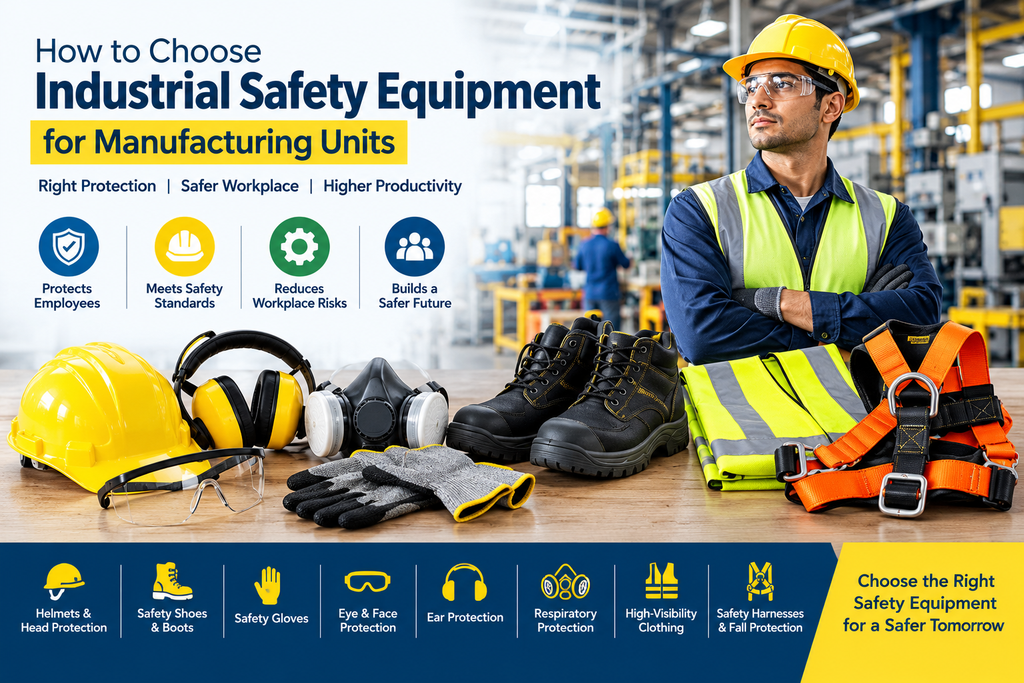
Depending on the industry, industrial safety equipment may include:
- Safety helmets and protective headgear
- Industrial safety shoes and boots
- Safety gloves for different applications
- Safety goggles and face shields
- Earplugs and earmuffs
- Respiratory protective equipment
- High-visibility safety clothing
- Safety harnesses and fall protection systems
Moreover, industrial safety equipment should be selected according to a proper workplace risk assessment. Personal protective equipment (PPE) is important, but it should complement other safety measures rather than replace them.
Why Is Industrial Safety Equipment Important for Manufacturing Units?
Manufacturing environments often involve several hazards at the same time. Consequently, selecting suitable protective equipment is essential for maintaining a safer workplace.
1. Protects Employees from Workplace Hazards
Workers may face risks from moving machinery, sharp edges, hot surfaces, dust, and chemicals. Suitable PPE helps reduce exposure to these hazards when correctly selected and used.
2. Supports Workplace Safety Procedures
A well-planned safety programme includes hazard identification, employee training, equipment inspection, and suitable protective gear. Therefore, choosing the right equipment helps factories follow consistent safety procedures.
3. Helps Meet Applicable Safety Requirements
Manufacturing businesses must identify and follow the safety requirements applicable to their operations. Depending on the product and its intended use, relevant Indian or international standards may apply.
For this reason, buyers should check product specifications and supporting certification documents before purchasing.
4. Improves Employee Comfort and Compliance
Workers are more likely to wear protective equipment correctly when it fits properly and suits the task. In addition, comfortable and durable PPE can support regular use during long working hours.
Types of Industrial Safety Equipment for Manufacturing Units
Different factory departments require different forms of protection. The following products are commonly considered when preparing a workplace safety plan.
1. Industrial Safety Helmets
Safety helmets help protect workers against specific head injury hazards, including impacts and falling objects.
They may be required in construction areas, manufacturing plants, warehouses, and maintenance zones.
Before selecting a helmet, consider the applicable standard, impact protection requirements, fit, compatibility with other PPE, and the manufacturer’s instructions.
2. Industrial Safety Shoes
Safety footwear helps protect workers against hazards such as impacts, compression, punctures, and slipping, depending on the footwear design.
For example, metalworking facilities may require protective toe caps, while warehouses may need footwear with suitable slip resistance.
When choosing industrial safety shoes, check:
- Toe protection requirements
- Sole grip and slip resistance
- Puncture resistance, where necessary
- Resistance to oil or chemicals, where specified
- Comfort, sizing, and durability
Importantly, electrical work may require specialised footwear selected for the actual electrical hazard. Ordinary safety shoes should not be assumed to provide electrical protection.
3. Industrial Safety Gloves
Safety gloves protect workers’ hands from task-specific hazards. However, glove materials and designs vary significantly.
Common options include:
- Cut-resistant gloves for handling sharp materials
- Heat-resistant gloves for suitable high-temperature tasks
- Chemical-resistant gloves for specific substances
- General-purpose gloves for handling and assembly
- Nitrile-coated gloves for suitable grip and handling applications
Before purchasing, check the glove’s material, protection level, compatibility with chemicals, and suitability for the task. Gloves can also create entanglement risks around certain rotating machinery, so they should only be used where appropriate.
4. Safety Goggles and Face Shields
Manufacturing processes such as grinding, cutting, drilling, and chemical handling may expose workers to flying particles, dust, or splashes.
Safety goggles and face shields provide different types of protection. Therefore, select equipment according to the hazard and the applicable protection rating.
For instance, chemical handling may require suitable splash-resistant goggles, while grinding operations may need impact-rated eye protection and a compatible face shield.
5. Hearing Protection Equipment
Factories using compressors, cutting machines, presses, and other noisy equipment may expose workers to excessive noise.
Depending on measured noise levels and the workplace assessment, suitable hearing protection may include earplugs or earmuffs.
In addition, businesses should consider noise reduction at the source and other engineering controls rather than relying only on hearing protection.
6. Respiratory Protection
Some manufacturing processes produce dust, fumes, vapours, or other airborne contaminants.
Respiratory protection must match the specific hazard. For example, a particulate-filtering mask is not automatically suitable for gases or chemical vapours.
Before selecting a respirator, assess the contaminant, concentration, oxygen conditions, fit, and applicable requirements. Where necessary, obtain advice from a qualified safety professional.
7. Welding and Heat Protection Equipment
Welding, fabrication, foundry work, and certain metalworking operations can expose workers to heat, sparks, and radiation.
Depending on the task, protection may include welding helmets, suitable gloves, flame-resistant clothing, and protective footwear.
For better protection, ensure that each item is suitable for the specific process and compatible with the other equipment being worn.
8. Safety Harnesses and Fall Protection
Manufacturing units may have elevated platforms, roof access points, storage systems, and maintenance areas where workers face fall hazards.
Depending on the risk assessment, suitable protection may include guardrails, work platforms, full-body harnesses, connectors, and compatible anchorage systems.
However, a harness alone is not a complete fall protection system. Correct selection, inspection, training, anchorage, and rescue arrangements are essential.
Seven Factors to Consider Before Buying Industrial Safety Equipment
Choosing safety products involves more than comparing prices. Consider these seven factors before placing an order.
1. Identify Workplace Hazards
First, review each department and job role. Identify risks such as sharp materials, moving machinery, heat, chemicals, noise, and electrical hazards.
This assessment helps determine the type of protection employees need.
2. Check Applicable Safety Standards
Next, review the relevant Indian Standards or other applicable standards for each product.
Ask suppliers for technical datasheets, product markings, and supporting test reports or certification documents where applicable. Do not assume that every product carrying a safety label meets every requirement.
3. Choose the Correct Size and Fit
Poorly fitting equipment may reduce comfort and protection. Therefore, check sizing options and ensure that employees can adjust the equipment correctly.
For respiratory protection, appropriate fit testing may be necessary depending on the respirator and applicable requirements.
4. Evaluate Material and Durability
Manufacturing conditions vary from one facility to another. For example, workers handling sharp metal sheets may need different gloves from employees performing general assembly work.
Consequently, compare materials, construction quality, expected service conditions, and the manufacturer’s maintenance instructions.
5. Consider Employee Comfort
Employees may wear PPE for several hours each day. Therefore, comfort, weight, ventilation, flexibility, and fit are important considerations.
At the same time, comfort should never come at the expense of the required protection level.
6. Compare Price and Total Cost
Low purchase prices do not always mean lower overall costs. Consider product life, replacement frequency, maintenance requirements, and the cost of supplying appropriate sizes to your workforce.
For bulk orders, request quotations from multiple suppliers and compare equivalent product specifications.
7. Check Supplier Support and Availability
A reliable supplier should provide clear product information and help buyers identify suitable options.
Before confirming an order, check stock availability, delivery timelines, bulk supply capacity, after-sales support, and the availability of replacement products.
Industrial Safety Equipment Checklist for Factories
Use this checklist as a starting point when reviewing your factory’s PPE requirements.
| Work activity | Equipment to consider |
|---|---|
| General manufacturing | Safety shoes, suitable gloves, eye protection |
| Metal fabrication | Welding protection, heat-resistant gloves, suitable footwear |
| Machine operation | Task-specific eye protection and other assessed PPE |
| Chemical handling | Chemical-compatible gloves, goggles, suitable protective clothing |
| Warehouse operations | Safety footwear, high-visibility clothing, suitable handling gloves |
| Noisy production areas | Hearing protection based on noise assessment |
| Dust-generating operations | Suitable respiratory protection and dust-control measures |
| Elevated maintenance | Appropriate fall prevention and fall protection systems |
This checklist is not a substitute for a site-specific risk assessment. The final selection should reflect the actual work process and applicable safety requirements.
Common Mistakes to Avoid When Buying Safety Products
Manufacturing businesses can improve purchasing decisions by avoiding these common mistakes:
- Buying PPE without assessing workplace hazards
- Selecting products based only on the lowest price
- Ignoring product specifications and applicable standards
- Choosing incorrect sizes or unsuitable materials
- Using one type of glove for every task
- Failing to train employees in proper equipment use
- Continuing to use damaged or unsuitable equipment
- Overlooking storage, inspection, and replacement procedures
Furthermore, businesses should review PPE requirements whenever machinery, materials, or work processes change.
Where to Buy Industrial Safety Equipment in India
Manufacturing companies should choose suppliers that offer suitable product options, clear specifications, and support for their purchasing requirements.
SafeKraft India Private Limited supplies workplace safety products for industrial and commercial applications. Businesses can explore the available product range for manufacturing, construction, warehousing, and other workplace environments.
Before ordering, confirm the exact product specification, suitability for your application, relevant documentation, stock availability, and delivery arrangements.
Explore SafeKraft: https://safekraft.co.in/
You can also contact the company to discuss your industrial safety equipment requirements and request a quotation for suitable products.
Conclusion
Choosing the right industrial safety equipment is an important part of workplace risk management. Manufacturing units should begin by identifying hazards and then select PPE that matches each task.
In addition, businesses should check product standards, evaluate fit and durability, train employees, and maintain regular inspection procedures.
By taking these steps, factory owners, purchase managers, and safety officers can make better purchasing decisions and support safer working conditions.
If your business needs workplace safety products, explore the available range at SafeKraft India and confirm which products are suitable for your manufacturing operations.
Frequently Asked Questions
1. What is industrial safety equipment?
Industrial safety equipment includes PPE and other protective devices used to reduce workplace risks. Examples include safety helmets, protective footwear, gloves, goggles, hearing protection, and fall protection equipment.
2. How do I choose industrial safety equipment for a factory?
Start with a workplace risk assessment. Then select suitable products, check relevant standards and specifications, confirm proper fit, and review supplier support and availability.
3. Which PPE is commonly used in manufacturing units?
Common PPE includes safety shoes, helmets, gloves, eye protection, hearing protection, and task-specific respiratory protection. The exact requirements depend on the hazards present.
4. Why are safety standards important when buying PPE?
Applicable standards help buyers evaluate whether a product meets defined performance requirements for its intended use. Buyers should verify relevant documentation rather than relying only on product descriptions.
5. How often should industrial safety equipment be replaced?
Replacement depends on the equipment type, its condition, frequency of use, exposure to hazards, and the manufacturer’s instructions. Damaged or unsuitable equipment should be removed from service.
6. Can one type of safety glove be used for every factory task?
No. Gloves must match the specific hazard. Cut-resistant, heat-resistant, chemical-resistant, and general-purpose gloves offer different types of protection.
7. Where can manufacturing companies buy industrial safety equipment in India?
Businesses can contact industrial PPE suppliers such as SafeKraft India. Before purchasing, verify the product specifications, availability, relevant documentation, and delivery arrangements.